
Live HTML Viewer
A live HTML viewer shortens the loop between changing source and checking the browser result. Paste or upload one document, render it, make a focused change, and refresh the preview without creating a project or starting a local server.
A Repeatable Live Preview Workflow
- Start with a complete document, including
<!doctype html>. - Render the page once to establish a known result.
- Change one thing at a time.
- Refresh the preview and inspect the visible result.
- Test phone and tablet widths.
- Publish only the version you reviewed.
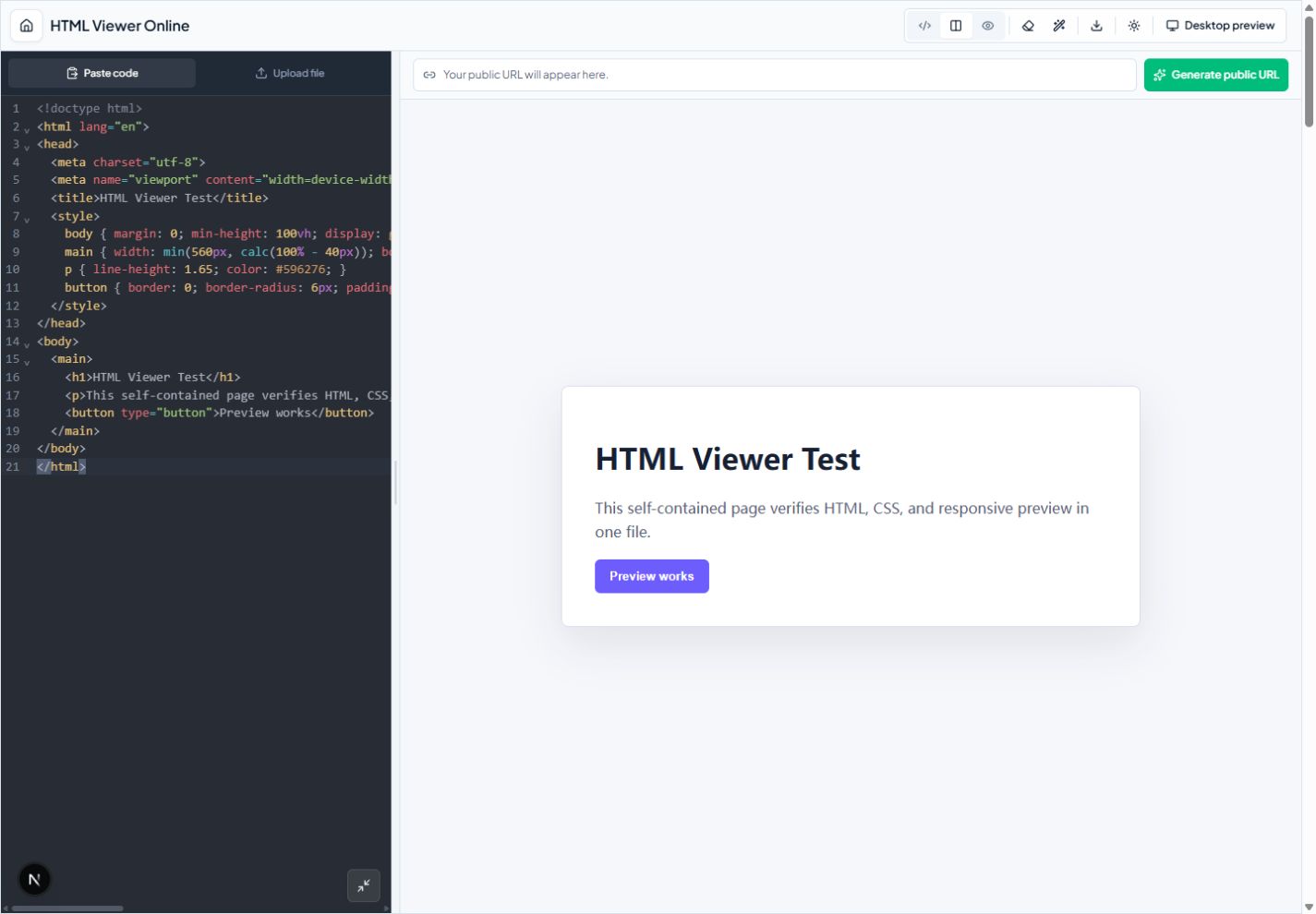
This workflow is deliberately small. Changing one variable at a time makes it easier to identify whether a problem comes from markup, a CSS rule, a script, or an external asset.
Test Document
The following self-contained document exercises markup, inline CSS, and a small browser-side script:
<!doctype html>
<html lang="en">
  <head>
    <meta charset="utf-8" />
    <meta name="viewport" content="width=device-width, initial-scale=1" />
    <style>
      body {
        font: 16px/1.5 system-ui;
        padding: 2rem;
      }
      button {
        padding: 0.65rem 1rem;
      }
    </style>
  </head>
  <body>
    <h1>Preview check</h1>
    <p id="status">The script has not run yet.</p>
    <button onclick="status.textContent = 'The script works.'">Run test</button>
  </body>
</html>
Paste it into HTML Viewer Online, render the page, and activate the button. Then change the spacing or message and refresh the preview.
Live Does Not Always Mean Every Keystroke
Some viewers update after each edit. Others require an explicit refresh or Run action. An explicit refresh can be more predictable for scripts, forms, and incomplete markup because you decide when the new document executes.
HTMLtoURL keeps editing and preview together while using a deliberate refresh step. The separate HTML Preview Online page covers the same basic source-to-result workflow from a preview-first angle.
For the terminology behind rendered output, source code, and editors, read what an HTML viewer is. The Android HTML viewer guide applies the same workflow to files opened on a phone.
Common Live Preview Problems
The Preview Is Blank
Check for an unfinished tag, a script that replaces the page, or content styled with display: none. Return to a minimal document and add sections back one at a time.
CSS Does Not Apply
Confirm that selectors match the elements and that external stylesheets use reachable HTTPS URLs.
JavaScript Does Not Run
Look for syntax errors, code that expects a missing library, or a handler that runs before its target element exists.
What Makes a Preview Live?
A live HTML viewer reduces the delay between changing source and seeing a rendered result. The editor records a change, the preview receives the new document, and the browser parses it again. Some tools perform that cycle after every keystroke. Others wait for a pause, require a Run button, or update only after a complete file is uploaded. All can support a fast workflow, but the timing affects how you test.
Immediate updates feel fluid for small snippets. They can become distracting when the document is temporarily invalid halfway through a change. A delayed update avoids unnecessary rendering while you type. A manual Run action is clearest when scripts have side effects, network requests cost money, or you need to decide exactly when code executes.
The useful measure is not the "live" label. It is whether the loop is predictable. Make one visible change, observe when the result updates, and learn whether focus, scroll position, form values, and console history survive. Those details determine how confidently you can use the preview.
Establish a Stable Baseline
Before editing, render the smallest complete version and record what correct looks like. Confirm the primary heading, one obvious style, one image if required, and one interactive behavior. A baseline gives you a known state to return to when a later change produces a blank or confusing result.
Change one category at a time. Start with semantic HTML, then add layout CSS, then decorative CSS, and introduce JavaScript last. If the page breaks after the script step, you can investigate behavior without questioning the entire structure. This order also produces a useful result for people who browse with scripts unavailable.
Keep the last working source outside the live editor if the tool has no version history. A refresh, expired session, or accidental selection should not erase the only good version. For project work, use version control; a live viewer is a feedback surface, not a replacement for commits.
Use Small Layout Experiments
When a layout looks wrong, avoid changing several declarations together. Add a temporary outline to the suspected container, set a clearly different background, or replace a complex grid with one column. The result identifies which element owns the unexpected width or spacing. Remove diagnostic styles after finding the cause.
Test content extremes rather than only polished sample copy. Replace a short title with a long one, remove an optional image, add list items, and use a long unbroken value in a table. A layout that works only with ideal content is fragile. The live loop makes these experiments quick enough to perform before handoff.
Responsive testing should use meaningful widths. A narrow phone width reveals overflow and crowded controls. A middle width exposes tablet transitions. A wide preview shows whether content stretches too far. Choose repeatable widths and note the result instead of dragging the pane randomly.
Understand State During Re-rendering
Many viewers replace the preview document whenever source changes. Text entered into a form disappears, an expanded disclosure closes, timers restart, and scroll position may return to the top. That is expected for a full reload. It can make interaction testing frustrating if you do not separate source edits from state testing.
Finish the relevant markup, then pause editing while testing a multi-step interaction. If application state must persist across code changes, a framework development server with hot module replacement is a better environment. It can update selected modules while preserving some state, although behavior varies by framework and component.
State loss can also hide defects. A form that fails only after data entry may never reach that condition if every edit resets it. Create a repeatable test sequence or temporary sample values. Remove personal data before saving or sharing the source.
External Resources and Network Timing
External resources make live feedback less deterministic. A remote style sheet may be cached, so a change appears to have no effect. A script may load slowly or fail behind a network policy. An API may reject the preview's origin. Start important experiments with inline CSS and self-contained logic; add external dependencies after basic behavior is proven.
When a dependency is necessary, use HTTPS, record its version, and observe the network request. A generic "latest" package URL can change after your test. A pinned version makes the preview reproducible. If a resource is private or needs a cookie, an online viewer is unlikely to match your authenticated environment.
Do not repeatedly trigger write operations from an auto-updating preview. A script that sends analytics, creates records, posts a form, or calls a paid API may run on every reload. Replace it with a harmless mock during visual work, or use manual execution.
Read Console Errors in Order
The first error often causes several later errors. If a required script fails to load, every function supplied by it may appear undefined. Fix the missing resource before debugging secondary messages. Clear the console, reproduce the problem once, and read from the top.
Syntax errors include a source location and usually a line or column. Runtime errors occur after parsing and include a stack trace. Network errors mean the browser could not obtain a resource or could not expose the response. A security message is not solved by randomly changing markup; identify the policy, origin, or permission involved.
Warnings still need context. An accessibility warning, deprecated API, or mixed-content notice may not blank the page, but it can indicate a production problem. Separate messages from the test document from messages created by the viewer interface itself.
Test Interaction and Accessibility
A visual update is only one part of a live preview. Navigate the result with a keyboard. Focus should follow a logical order, buttons should activate with expected keys, and a visible focus indicator should remain. Change browser zoom and system text size to check whether labels and controls still fit.
Use native HTML before creating custom interaction. A real button already supports keyboard activation; a clickable generic container does not. A label connected to an input increases the clickable area and gives the control an accessible name. Live feedback makes these details easy to verify while building.
For changing content, consider what an assistive technology user would learn. A status update may need an appropriate live region, while a decorative animation needs no announcement. A viewer helps inspect markup, but a complete accessibility review also needs keyboard testing, automated checks, and human judgment.
Know When to Use a Development Server
A live viewer is ideal for one document, a reduced bug case, a teaching example, or a visual review. Move to a local development server for multiple routes, package imports, framework compilation, service workers, authentication, server endpoints, or a structured asset pipeline. A standalone document cannot reproduce those features faithfully.
Preserve the useful test during the transition. Place the validated structure into the project, move styles into its established system, and convert temporary data into fixtures or mocks. Repeat the same width and interaction checks in the real application. Differences reveal assumptions made by the isolated preview.
Keep a reduced example when it documents tricky browser behavior. It can become a regression test, support reference, or clear code-review explanation. Remove sensitive data and date the result so future readers know its context.
Live Preview Review Checklist
Use a final pass another person can repeat:
- Reload from a clean state and confirm the first render.
- Change one visible value and verify the update timing.
- Test narrow, middle, and wide preview widths.
- Activate links, buttons, forms, and keyboard focus in order.
- Review the first console error and every failed network request.
- Retry without external resources to reveal hidden dependencies.
- Confirm that the source contains no tokens, private URLs, or personal records.
- Save the final code somewhere with revision history.
Describe the browser, date, and viewer restrictions when sharing the result. A live preview is most valuable when the next reviewer can reproduce the expected and failed states without guessing which update mode or resources you used.
Frequently Asked Questions
What is a live HTML viewer?
A live HTML viewer is an editor and browser preview that lets you change HTML and repeatedly render the updated result in the same workspace.
Can a live HTML viewer run CSS and JavaScript?
Yes, when the CSS and browser-side JavaScript are included in the document or loaded from reachable sources. Server-side code does not run inside a static HTML preview.
Is a live viewer a replacement for local development?
It is useful for one-file tests and reviews. Projects with modules, build tools, several routes, a backend, or private environment variables still need a development and deployment workflow.